
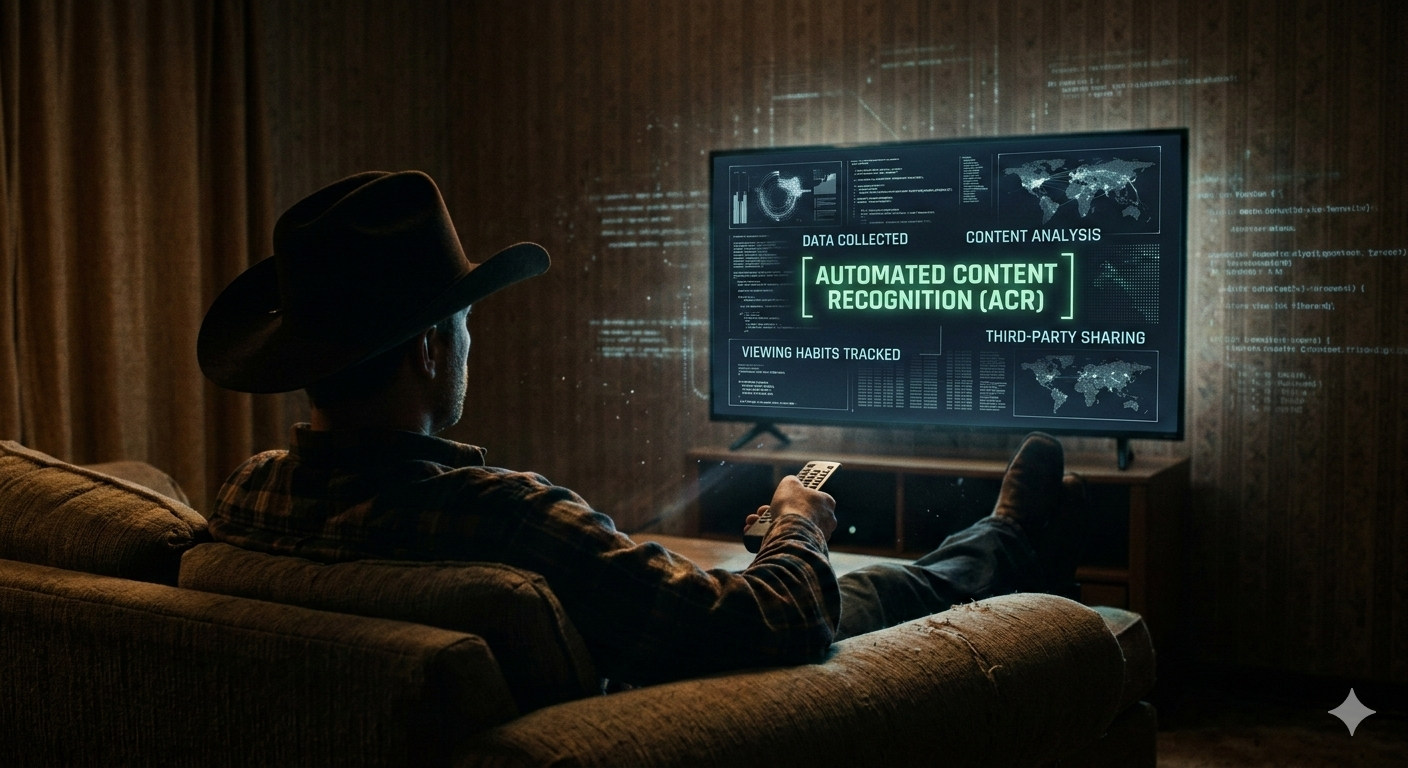
This just in…the Texas AG just scored another privacy settlement.
A landmark agreement between Texas Attorney General Ken Paxton and Samsung marks a pivotal moment in the fight against covert data collection — and sends a warning shot to an entire industry.
Every night, millions of Americans settle onto their couches (or like me, lay in bed), flip on their smart TVs, and think nothing of it. What they don’t realize — or didn’t, until now — is that their television was quietly taking notes. Logging every channel surfed, every streaming service browsed, every program paused and rewound. This practice has a technical name: Automated Content Recognition, or ACR. And for years, it operated largely in the shadows of consumer awareness.
That era may be ending — at least in Texas, and potentially far beyond its borders. Texas has been on a tear when it comes to data privacy settlements!
Key Data Privacy Settlements by the Texas Attorney General:
- Meta (Facebook) – $1.4 Billion (2024): Settled allegations of capturing and using personal biometric data (facial recognition) without proper consent, violating Texas’s “Capture or Use of Biometric Identifier” (CUBI) Act.
- Google – $1.375 Billion (2025): Resolved allegations that Google unlawfully tracked, collected, and monetized Texans’ private user data, including location tracking and voice prints.
- Equifax – Multi-state Settlement (2019/2020): Texas was part of a settlement regarding the 2017 data breach, with Texas specifically securing significant relief and a share of a $600 million-plus settlement for exposed data of over 12 million Texans.
- Blackbaud, Inc. – (2023): Settled investigations into a 2020 ransomware attack that exposed sensitive consumer, donor, and protected health information.
- Pieces Technologies – (2025): Settlement regarding the accuracy and safety of AI products used in hospitals, following investigations into deceptive trade practices
What the Samsung Agreement Actually Means
Attorney General Ken Paxton announced a significant legal settlement with Samsung Electronics America following a lawsuit over the company’s ACR data collection practices. Under the terms of the agreement, Samsung must immediately halt all collection and processing of ACR viewing data unless it first obtains the express, informed consent of Texas consumers. See the Czar’s article on the recent Fifth Circuit Court of Appeals decision on express, informed consent.
That means no more quiet opt-ins buried in 47-page terms-of-service documents. No more pre-checked boxes during setup. Samsung is now required to implement clear, conspicuous disclosure and consent screens — interfaces specifically designed to ensure that consumers actually understand what they are agreeing to before any data leaves their living rooms… or their bedrooms.
Key Terms of the Agreement – What Samsung Must Now Do
- Immediately halt the collection and processing of ACR viewing data without express prior consent from Texas consumers
- Update existing smart TV software to implement new consent mechanisms
- Deploy clear, conspicuous disclosure screens — not fine print, not buried menus
- Ensure consumers can make a fully informed decision about whether their data is collected
- Provide transparency about how collected data is used and by whom
What Is ACR Data — and Why Should You Care?
Automated Content Recognition is a technology embedded in modern smart TVs that works much like Shazam does for music — except instead of identifying songs on demand, it continuously fingerprints everything displayed on your screen. ACR software captures snippets of your viewing activity and matches them against vast databases to identify exactly what you’re watching, when you’re watching it, and for how long.
This data is extraordinarily valuable. Advertisers use ACR profiles to serve highly targeted ads across your other devices. Data brokers purchase it to build comprehensive behavioral profiles. Insurance companies, political campaigns, and financial services firms have all been identified as potential buyers. The granularity of the information — not just “this household watches sports” but “this person watched three political ads, paused on a pharmaceutical commercial, and regularly stays up past midnight” — represents a level of behavioral insight that would have seemed implausible a decade ago.
Texas AG declared that, “Texans must be fully informed about whether their data is collected and be in full control of how it’s used.” — Attorney General Ken Paxton
The unsettling reality is that most consumers have no idea this is happening. Unlike a web browser, where the presence of cookies and trackers has become a familiar concept, the television set carries a different cultural assumption — one of passive entertainment rather than active surveillance. The TV watches you watch it, and the asymmetry of that relationship has been exploited commercially for years.
The Bigger Picture: A Warning to the Industry
While the agreement with Samsung represents genuine progress, Attorney General Paxton was explicit that the resolution was partly a commendation and partly a warning. Samsung, he noted, deserves credit for being “one of the first smart TV companies in the world to make these important changes.” The implication was pointed: others have not!
In the same statement, Paxton made clear that legal actions against other smart TV manufacturers — companies he characterized as having “chosen to illegally spy on Texans and act as digital invaders in their homes” — will continue to move forward. The Samsung deal is not an endpoint. It’s a template, and a pressure tactic. And why not continue to pursue these matters? So far, Texas has been very successful in recovering large settlements from companies for data privacy issues.
What This Means for Consumers Everywhere
The agreement formally applies only to Texas consumers, but its practical reach is likely to extend further. Because Samsung sells a single line of products nationally, the most cost-effective path to compliance may be to roll out updated consent mechanisms to all U.S. customers — or even globally. Consumer advocates have noted this “California effect” before: when one large jurisdiction mandates change, the change often propagates across the market. And everything is bigger in Texas! So one would imagine this will have a bigger impact.
More fundamentally, this settlement establishes a critical precedent about what informed consent actually means in the context of smart home devices. It is not enough to disclose data collection practices somewhere in a user agreement that no one reads. Consent must be conspicuous, comprehensible, and genuinely voluntary. The moment a consumer powers on a Samsung smart TV, they will now be confronted with a real choice — not a hidden default.
The Consent Problem Is Bigger Than TVs
For privacy advocates, the Samsung case illuminates a broader crisis in consumer data governance. The model that has dominated the digital economy — collect everything, disclose minimally, profit enormously — has been challenged in courtrooms, legislatures, and public discourse for years. But meaningful enforcement has remained elusive.
What makes this agreement notable is that it targets a device category that has historically flown under the radar of privacy scrutiny. Your phone collects data; that’s common knowledge, however uncomfortable. Your TV, which has been collecting similar data, has been far less visible to consumers. By forcing a major manufacturer to implement genuine consent mechanisms on a ubiquitous household device, the Texas AG’s office has helped close a significant gap in the public’s understanding of where surveillance capitalism actually lives.
The television set was once just a box in the corner of a room. Then it became a portal to the internet. Now, apparently, it has been a portal in the other direction too — a window through which your habits, preferences, and daily rhythms flow outward to data brokers and advertisers you’ve never heard of and never chosen to engage with.
Whether through regulatory action, litigation, or market pressure, the expectation that consumers should know when they’re being watched — and have a genuine say in the matter — seems finally to be gaining enforceable teeth. The Samsung agreement won’t solve the surveillance economy. But it does establish, in the most concrete terms possible, that the living room and bedroom are not a free-fire zone for data extraction, and that silence has never been consent.
How’s that for a data privacy event!
If you want assistance in evaluating your obligations to consumers and customers regarding data privacy rights, reach out to Troutman Amin.
Have a great day!
 CIPAWorld